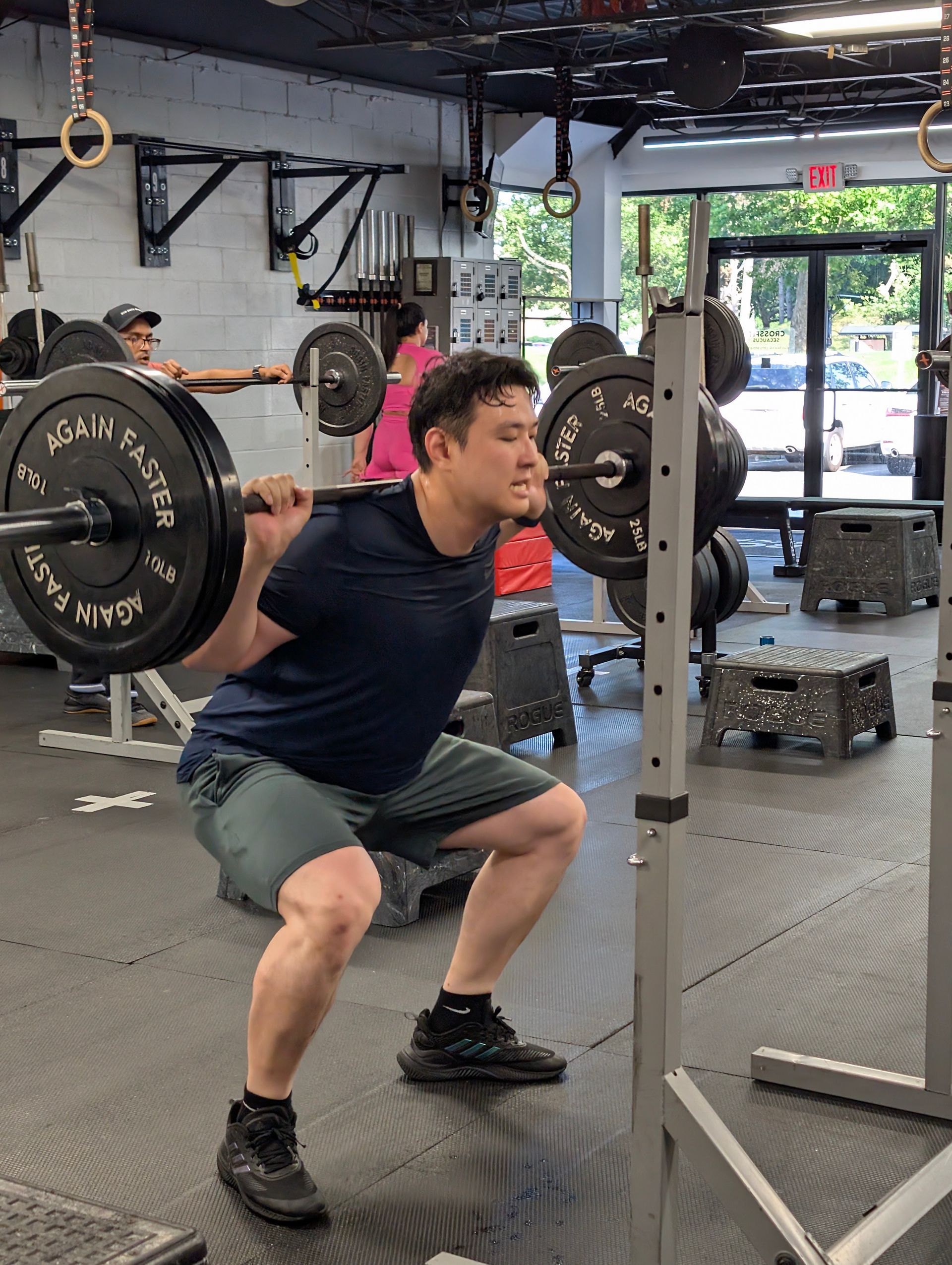
I Used to Do CrossFit But Burned Out. Here Is Why CrossFit Secaucus Might Be Different.
What actually causes CrossFit burnout and how we coach returning athletes differently at CrossFit Secaucus.
By Rob Zych | CrossFit Secaucus | Secaucus, NJ
This one is not for the person who has never tried CrossFit. If you have never stepped into a CrossFit gym before, we have other articles for you — about what to expect, how scaling works, why it is more beginner-friendly than it looks on television.
This one is for you: the person who has already done CrossFit. Who went three, four, maybe five times a week for a while. Who made real progress. Who genuinely liked parts of it. And who eventually stopped — because the volume was unsustainable, because something kept getting hurt, because the culture at that particular gym stopped feeling like a place you wanted to be, or because life simply got in the way and the momentum broke.
You are not a beginner. But you are not currently training either. And you are wondering whether coming back makes sense — and whether it would just end the same way.
That is a reasonable thing to wonder. Let me try to give you an honest answer.
What CrossFit Burnout Actually Is (Because It Varies)
Before we talk about what we do differently, it is worth naming what actually went wrong, because "I burned out" covers a lot of different situations. The fix depends on the cause.
The Volume Was Unsustainable
Some people burn out because they did too much, too consistently, for too long. Five days a week is a lot. Five days a week at high intensity, week after week, without adequate recovery programming, is a formula for eventually breaking down. Your body adapts to training stress only when it also gets the recovery stimulus to adapt. When that balance tips too far toward volume, performance starts declining, small injuries accumulate, and motivation collapses. The gym starts feeling like an obligation rather than something that makes you feel better.
This is one of the most common versions of CrossFit burnout I see, and it is almost entirely a programming and culture problem, not a you problem.
Something Kept Getting Hurt
For some people, burnout was really injury accumulation in slow motion. A shoulder that never fully resolved. A lower back that kept flaring. A knee that felt fine during the workout and terrible the next morning. Each injury took them out for a few weeks, they came back, it came back, and eventually the cycle of disruption was not worth continuing.
Recurring injury in CrossFit usually has one of a few causes: mechanics that were never corrected at the root, loads that exceeded what the current movement quality could safely support, or programming that did not build in adequate recovery between similar stimuli. A good coach catches these things early and addresses them before they become the reason someone stops training.
The Culture Stopped Fitting
This one is less discussed but very real. CrossFit gyms vary enormously in culture. Some are genuinely competitive environments where the social currency is performance, and where someone who wants to train hard but does not want to post benchmark scores on a whiteboard or compare times with the person next to them feels slightly out of place. That culture works well for a certain type of athlete. It does not work well for an adult in their 40s who wants to get strong, feel better, and leave without a debrief on their split times.
If the culture was the problem, the solution is finding a gym whose culture actually matches what you want. That is not a criticism of the gym you left. It is an acknowledgment that different environments serve different people.
What We Do Differently at CrossFit Secaucus
I am not going to tell you we are perfect or that we are right for everyone. What I can do is describe specifically what we prioritize and why, and let you decide whether it fits where you are now.
The Programming Is Strength-Biased and Built for Adults
Our programming is not designed for twenty-five-year-old competitive athletes who want to qualify for Regionals. It is designed for working adults who want to get meaningfully stronger, improve their conditioning, and still be able to function well outside the gym.
That means we program strength work with intention — not as a brief warmup before the "real" workout, but as a central component of most sessions. It means our conditioning pieces are typically in the eight-to-sixteen minute range, not thirty-minute sufferfests. It means we rotate formats and movement patterns in a way that is designed to avoid the overuse patterns that tend to cause the recurring injuries described above.
If you trained at a gym where the programming was heavy on volume and light on recovery, you may find the approach here quite different.
Scaling Is Not an Accommodation. It Is Coaching.
At some CrossFit gyms, scaling is treated as a temporary concession — something you do until you are ready for the "real" workout. The implication, sometimes subtle and sometimes not, is that you are working toward Rx and anything short of that is a lesser version.
We do not operate that way. The appropriate version of any workout is the version that delivers the intended training stimulus for your body, your current capacity, and your goals. For some people that is Rx. For others it is sixty percent of Rx. Neither is better or worse; they are both intelligent training.
For someone returning to CrossFit after time away or after a history of injuries, the appropriate version of a workout often looks different from what you did three years ago. That is not regression. It is smart re-entry.
Small Classes Mean You Are Actually Coached
This is not a marketing line. Class size has a direct and practical effect on the quality of coaching you receive. When a coach is managing a class of twenty-five people, they are doing crowd control. When they are managing a class of eight to twelve people, they can watch your movement, catch compensations before they become problems, and adjust your load or mechanics in real time.
We keep our class sizes deliberately small because the coaching standard we hold ourselves to cannot be maintained at scale. If you have trained at a gym where you felt anonymous — where you went through the workout and left without the coach really knowing what was happening with your body — that is not how things work here.
There Is No Pressure to Perform
We do not have a PR board culture where your performance is a social signal. We celebrate consistency. We celebrate someone finally achieving a movement they have been working on for months. We do not celebrate suffering for its own sake.
Adults who come back to CrossFit after burning out often need a different relationship with intensity than the one they had before. We are not interested in seeing how much you can tolerate. We are interested in building you up over time in a way that is sustainable for the long term.
What Returning to CrossFit Actually Looks Like Here
Before anyone joins CrossFit Secaucus as a full member, they go through our OnRamp program — four one-on-one sessions with me personally. This is true for true beginners, and it is equally true for returning athletes.
I am aware that for someone who has been doing CrossFit for years, the idea of going through an onboarding process might feel unnecessary. I understand that instinct. But here is why it matters for someone returning after burnout or injury, specifically.
First, a lot changes. If it has been two or three years since you trained seriously, your capacity is not where it was. Starting at the load you used to use, or at the volume you used to manage, is a reliable path back to the same outcome you had before. OnRamp is where we establish where you actually are right now, not where you were.
Second, it gives us the opportunity to understand your history. If your shoulder was always a problem, I want to know that before your first class. If your lower back tends to flare after heavy deadlifts, I want to know what that pattern looks like so we can program around it rather than into it.
Third, it builds the right relationship with intensity from the beginning. Coming back at an appropriate pace is not a compromise; it is the approach that produces long-term results. OnRamp is where we calibrate that together.
What About Personal Training?
For some returning athletes, particularly those with complicated injury histories or very specific goals, personal training is actually the better re-entry point rather than group classes.
We offer one-on-one personal training at CrossFit Secaucus, and for the right person, it is a better fit than immediately returning to group training. If you have a shoulder that has never been properly addressed, personal training gives us the space to work through that specifically before adding the variable of group class intensity. If you have a very defined performance goal — returning to a particular level of conditioning for a specific purpose — one-on-one programming can be built around that objective in a way that group programming is not designed to do.
If personal training is a better starting point for your situation, we will tell you that honestly in our initial conversation. We are not in the business of putting people in the wrong program because it is more convenient.
The Honest Conversation Worth Having
If you used to do CrossFit and stopped, I am not here to convince you that what went wrong before will not go wrong again. I do not know your specific situation well enough to make that claim.
What I can offer is a conversation. Our No Sweat Intro is a free, thirty-minute, one-on-one meeting where we talk about what your training history looks like, what happened when things went sideways, what you are actually trying to accomplish now, and whether CrossFit Secaucus is genuinely the right environment for where you are. If it is not, I will tell you that. If it is, we will talk about what re-entry actually looks like.
No sales pressure. No commitment. Just an honest conversation with someone who has been coaching since 2012 and has worked with a lot of people who share your exact situation.
If you are in the Secaucus, North Bergen, Kearny, Jersey City, Hoboken, or surrounding Hudson County area and you are thinking about coming back to training, we would like to talk.
Schedule Your Free No Sweat Intro Here.
CrossFit Secaucus | 230 five-star Google reviews | Secaucus, New Jersey
Head Coach: Rob Zych, CrossFit Level 2 | Assistant Coach: Debbie, CrossFit Level 2
CrossFit Secaucus serves adults throughout Hudson County including Secaucus, North Bergen, Kearny, Jersey City, Hoboken, and the surrounding area. We specialize in beginner-friendly CrossFit coaching, OnRamp programs, and personal training for adults of all ages and fitness levels.